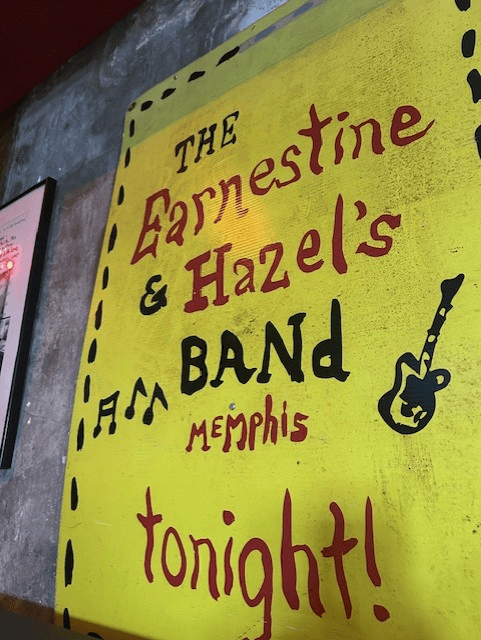
On a random Saturday, my mind drifts back to a sign in Memphis: Earnestine and Hazel’s. A name that stopped me in my tracks before I ever walked through the door. It belonged to my paternal grandmother and my aunt. It felt like a summons. Add in the rumor of hauntings and the promise of a dive bar atmosphere, and I was all in.
It was, indeed, a dive. Worn floors, dim lighting, walls that had absorbed decades of music and stories. But what lingered most wasn’t the aesthetic — it was the people. The locals were warm in an unceremonious way. No pretense. No performance. Just a casual, easy welcome extended to a couple of Nebraska visitors clearly out of place and entirely embraced. We talked in July heat about life and history and neighborhood lore. For a moment, we weren’t outsiders. We were just part of the room.
The sign outside called it a “sundry store.” I later learned that meant a place selling various small necessities — odds and ends, everyday items. But the word feels larger than its definition. A sundry store wasn’t just commerce; it was connection. A little bit of everything for everyone. A place where needs were met, yes — but also where conversations happened, news spread, and community was stitched together in small, ordinary exchanges.
That memory feels strangely connected to yesterday.
Family came into town to tour the traveling Holocaust exhibit — a sobering, weighty reminder of humanity at its worst. Afterward, we gathered at Kincaiders. I looked around and saw Kearney alive — tables filled, laughter spilling out, families sharing meals. Later, Bierhaus Maisschäler buzzed with that familiar rhythm of clinking glasses and long conversations. Good food. Good brews. People leaning in toward one another.
And it struck me: even in heavy times, even in complicated seasons, community persists.
There is so much noise right now — tariffs debated on screens, leadership that feels uncertain or self-serving, planning missteps, bureaucratic red tape, power struggles. Systems strain. Institutions wobble. It can feel exhausting to care.
But then there are these moments.
A dive bar in Memphis where strangers welcome you like regulars.
A family choosing to engage hard history together.
A small Midwestern downtown humming with life on an ordinary evening.
The macro can feel chaotic. The micro is often tender.
There’s something grounding about noticing that. Not in a naïve, ignore-the-problems way. The problems are real. Leadership gaps are real. The frustrations are real. But so is the fact that people keep showing up for one another. They gather around tables. They tell stories. They remember names. They honor history. They build small rituals of belonging.
Maybe that’s what draws me to places like Earnestine and Hazel’s — spaces layered with memory. Haunted, perhaps, not by ghosts but by the residue of community. Generations of voices embedded in the walls. Proof that people have been gathering long before us and will continue long after.
In both Memphis and Kearney, I felt the same undercurrent: the quiet resilience of ordinary people. No grand speeches. No sweeping reforms. Just the steady act of being decent. Welcoming the outsider. Pouring another drink. Pulling up a chair. Listening.
It feels important to name that. To hold onto it.
Because in seasons where leadership falters or systems feel heavy, community becomes the counterweight. Progress isn’t always loud. Sometimes it looks like a full table. Sometimes it sounds like laughter in a brewery. Sometimes it feels like a stranger calling you “hon” in a dive bar that bears your grandmother’s name.
Still finding the good among the craziness.
Not because the craziness isn’t there.
But because the good is, too.
And perhaps that — the stubborn, ordinary goodness of people gathering — is what keeps everything else from unraveling.

